.webp)


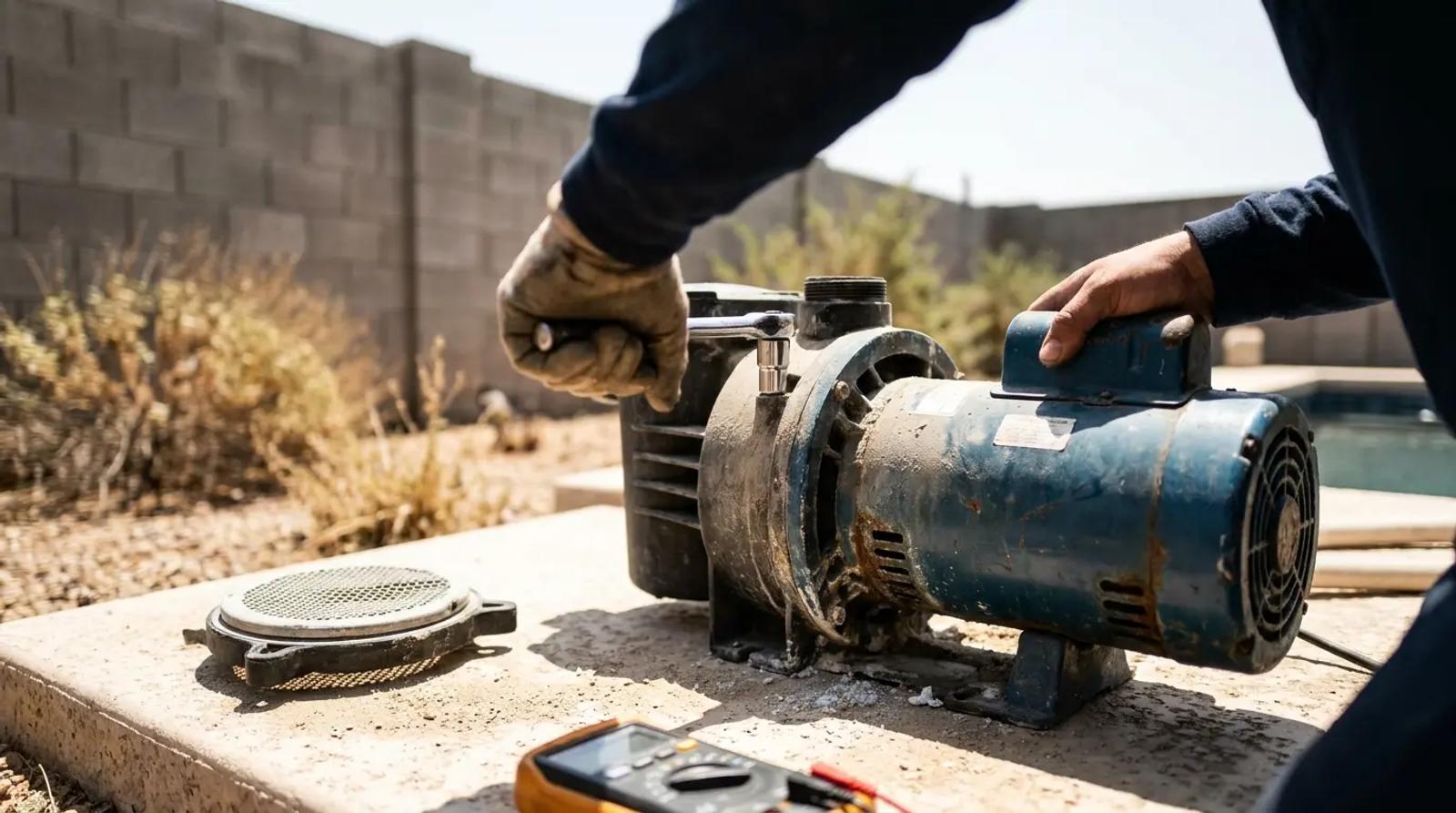
Your pool pump is the heart of the whole system. When it goes, everything downstream goes with it: the water stops moving, chlorine stops mixing, the filter stops working, and a clear pool can turn cloudy in a day or two.
The good news is a pool pump almost never fails out of nowhere. It warns you first. A new noise, a leak, a breaker that keeps tripping. Catch those signs early and you are often looking at a small repair instead of a full pump replacement.
We are Nick and Kevin, the owners of All In Pools. We have repaired pool pumps across the Las Vegas Valley for over 15 years. Here are the warning signs your pool pump is failing, what each one usually means, and when it is time to call a pro.
Why Pool Pumps Fail Faster in Las Vegas
Before the signs, it helps to know why pumps struggle here. The desert is hard on equipment, and a pump motor takes the worst of it.
Heat is the big one. A pump motor already runs hot. Park it in 110-degree summer air with no shade, and it runs hotter. Heat is the number one killer of pool pump motors in Southern Nevada.
Hard water scale builds up inside. Las Vegas has some of the hardest water in the country. Calcium scale builds inside the pump housing and on the seals, which makes the motor work harder.
Caliche dust gets everywhere. Fine desert grit works its way into the motor and the bearings. Over time it wears them down and turns a quiet pump into a noisy one.
Evaporation drops the water line. When summer evaporation pulls the water below the skimmer, the pump starts sucking air instead of water. That leads to air leaks and a pump that loses its prime.
A pump that lives in full Las Vegas sun and never gets shade or service is on borrowed time. We have replaced motors that should have lasted ten years and died in four, just from heat and neglect.
Sign 1: Strange Noises From the Pump
Noise is the most common early warning, and the type of noise tells you a lot. A healthy pump should run with a steady, low hum. Anything louder or sharper is a flag.
- Loud humming with no water movement: Often a bad capacitor. The motor is trying to start but cannot.
- Grinding or growling: Usually worn bearings inside the motor. This gets worse fast.
- Screeching or squealing: Also bearings, often dried out from heat. Do not ignore this one.
- Rattling: Can be a loose part, debris in the pump basket, or a failing motor mount.
Here is a quick guide to what each sound usually points to.
| Sound | Likely Cause | How Urgent |
|---|---|---|
| Loud hum, no flow | Failing capacitor | High, motor can burn out |
| Grinding or growling | Worn motor bearings | High, gets worse fast |
| Screeching or squealing | Dried-out bearings | High, address right away |
| Rattling | Loose part or debris | Medium, check the basket first |
Sign 2: Weak Water Flow or Low Suction
Walk over to your return jets. The water should push out with steady pressure. If the flow is weak or the jets are barely moving water, your pump is not pulling like it should.
Weak flow usually traces back to one of these:
- A clogged pump basket or skimmer basket
- A clogged or jammed impeller, the part that actually moves the water
- An air leak on the suction side
- A scaled-up or worn pump from years of hard water
Sometimes the fix is simple, like clearing the basket. Other times a clogged impeller or a worn pump needs a pro to open it up. Weak flow also means your filter is not doing its job, which is why the weekly cleaning and the equipment side go hand in hand.
Sign 3: The Pump Is Leaking Water
A puddle under the pump is never normal. Pool pump leaks usually come from a few specific spots, and where the water shows up tells you the source.
- Leaking from the pump lid: Often a dried-out or cracked pump lid o-ring. Common in the desert, where heat dries rubber out fast.
- Leaking from the back of the pump near the motor: Usually a failed shaft seal. This one needs attention, because water getting into the motor can destroy it.
- Leaking from the pump housing or body: Can be a crack, often from age, freeze stress, or scale.
A small lid leak might be a cheap fix. A shaft seal leak left alone can take out the whole motor and turn a minor repair into a full pump replacement.
Nine times out of ten, a leak at the back of the pump is a shaft seal, and the clock is ticking. Once water reaches the motor windings, you are buying a new motor instead of a 30-dollar seal.
Sign 4: The Pump Keeps Tripping the Breaker
If your pool pump trips the circuit breaker, do not just keep flipping it back on. The breaker is doing its job. It is telling you something is wrong.
A pump that trips the breaker usually points to:
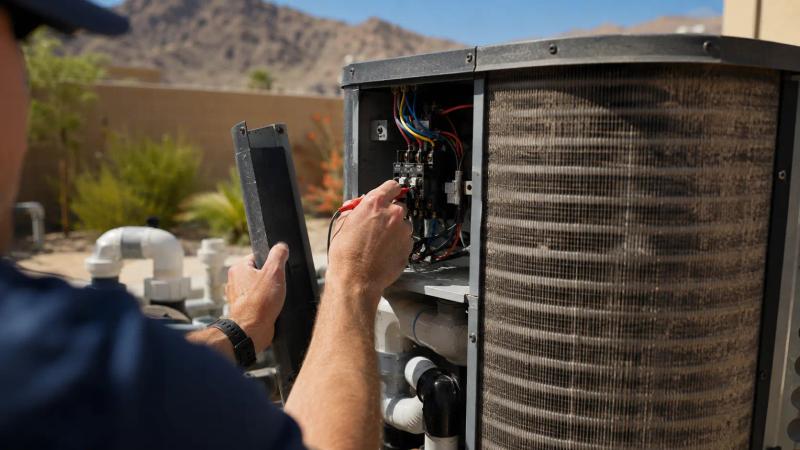
- An overheating motor, often from desert heat or poor airflow
- A failing capacitor or motor winding
- A wiring or electrical fault
- A motor pulling too much power as it wears out
This is one to take seriously. Repeatedly resetting a tripping breaker can damage the motor for good and creates a real safety risk. Call a pro before you keep flipping it.
Sign 5: The Pump Is Overheating or Shutting Off
Modern pump motors have a thermal cutoff. When the motor gets too hot, it shuts itself down to protect itself, then turns back on once it cools.
If your pump runs for a while, shuts off, then kicks back on later, it is overheating. In Las Vegas, the usual suspects are:
- Full sun with no shade or ventilation on the equipment pad
- A motor near the end of its life
- Low water flow forcing the motor to work harder
- Dust and debris blocking the motor's cooling vents
An overheating pump is living on the edge. Once a motor starts cycling on heat, replacement is usually not far off.
Sign 6: The Pump Won't Turn On at All
Sometimes the pump just will not start. You flip the switch and get nothing, or you hear a hum but the motor never spins.
Common causes include a dead capacitor, a seized motor, a tripped breaker, or an electrical issue. A humming pump that will not spin is very often a capacitor, which is a common and fixable repair if you catch it before the motor burns out from trying.
Sign 7: Cloudy Water and a Dirty Pool
This one is easy to miss because it does not look like a pump problem. But your pump and filter are what keep the water clear. When the pump weakens, the water stops circulating and filtering the way it should.
If your pool water becomes cloudy even though your chemistry is balanced and you are cleaning regularly, a weak or failing pump may be the real reason. The water simply is not moving through the filter enough to stay clear.
If it has already tipped into green or heavy cloudiness, our green-to-clean service can recover it while we sort out the pump.
Repair or Replace? What We Look At
Not every pump problem means a new pump. Plenty are simple fixes. Here is how we think about it on a service call.
| Problem | Usually a Repair | May Need Replacement |
|---|---|---|
| Leaking pump lid o-ring | Yes, simple part swap | No |
| Bad capacitor | Yes, common repair | No |
| Clogged impeller | Yes, clean it out | No |
| Worn bearings | Sometimes, depends on age | Often, if motor is old |
| Shaft seal leak into motor | If caught very early | Often, motor may be done |
| Motor burned out | No | Yes |
If you are replacing the pump anyway, this is the moment to think about a variable-speed pump. In Las Vegas, a variable-speed pump cuts pump electricity use by 50 to 80 percent, and most homeowners see the payback in a season or two on the NV Energy bill. Our equipment upgrade service handles that swap.
When to Call for Pool Pump Repair
Some pump problems can wait a day. Others should not. Call a pro right away if you notice any of these:
- The pump is grinding, screeching, or growling
- The breaker keeps tripping
- Water is leaking from the back of the pump near the motor
- The pump shuts off on its own and restarts
- The pump hums but will not spin
- The water is going cloudy despite good chemistry
The longer a failing pump runs, the more likely a cheap repair turns into a full motor or pump replacement. Catching it early almost always saves money.
Get Expert Pool Pump Repair in Las Vegas
A failing pump is not a wait-and-see problem. When the heart of your pool struggles, the whole system follows. All In Pools diagnoses and repairs pool pumps, motors, and equipment in-house, and because we do cleaning AND repair, we keep your water clear while we fix the pump.
We serve homeowners and businesses across the entire Las Vegas Valley, including Summerlin, Henderson, Spring Valley, North Las Vegas, Paradise, Enterprise, Green Valley, Boulder City, and Lake Las Vegas.
Call us at (702) 381-1966 or request your free quote online. One of the owners, Nick or Kevin, will get back to you within one business day. Repairs are often same-visit when the part is on the truck, so you are back to a pool that just works.
.jpg)